
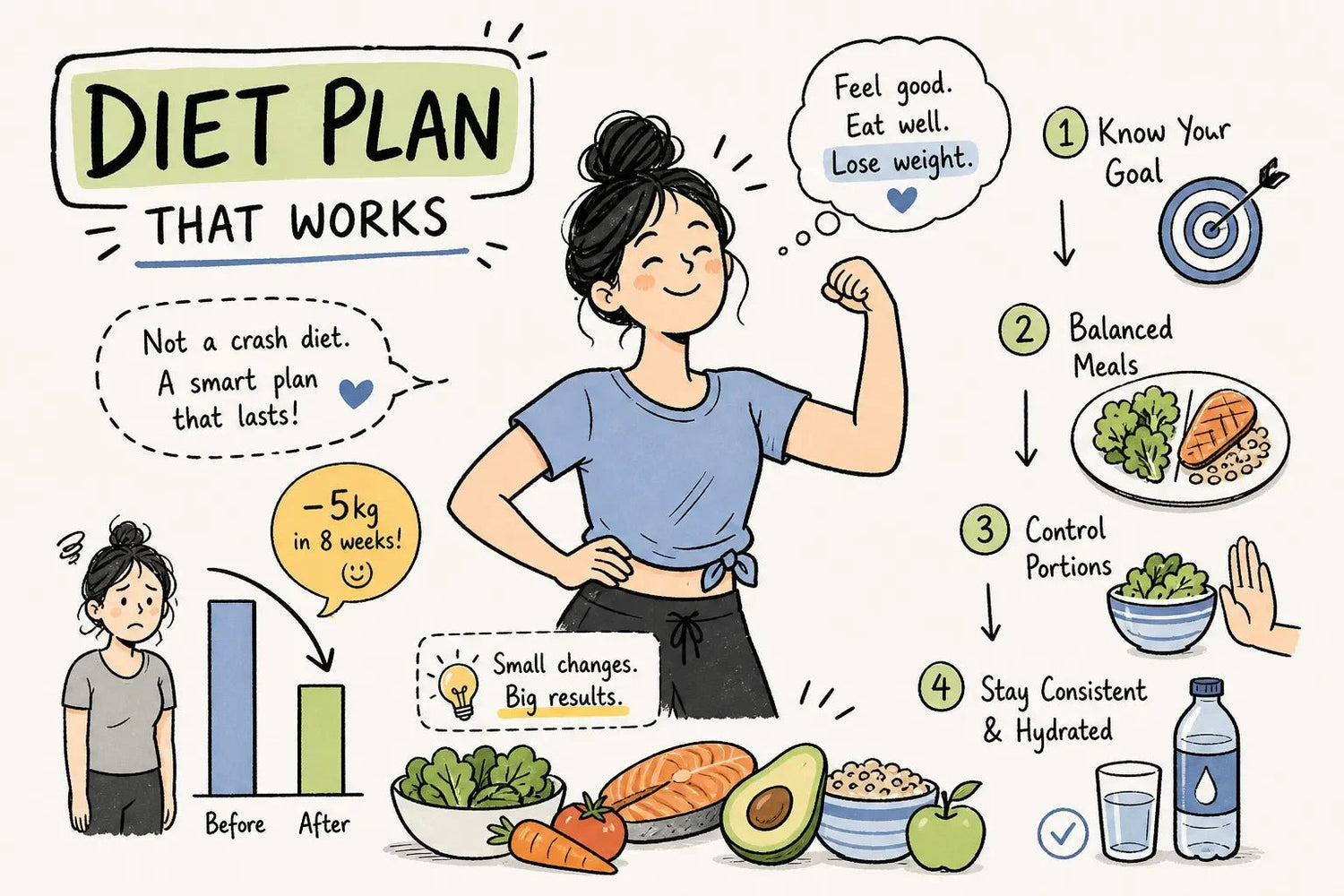
If you're looking for a practical lose weight diet plan, this article delivers the calorie math, macro targets, a 4-week meal plan framework, and the daily habits that separate people who keep the weight off from those who regain it within 90 days. Most people don't fail at weight loss because they lack discipline. They fail because they started with a plan that was too aggressive, too vague, or built around rules nobody can sustain past week three. A solid diet plan to lose weight isn't about eating as little as possible or cutting out entire food groups. It's about understanding a few non-negotiable fundamentals and applying them consistently. No gimmicks. No starvation. Just a clear, usable system you can start this week.
What safe weight loss actually looks like
The CDC, NIH, and Mayo Clinic all point to the same target: 1 to 2 pounds per week. That's not a conservative estimate meant to slow you down. It's the rate at which your body loses actual fat rather than muscle or water. A 500 to 750 calorie daily deficit produces this result. Anything beyond 2 pounds per week typically signals muscle loss and metabolic stress, not faster progress.
Rapid weight loss creates a short-term win followed by a sharp rebound. When you drop calories too low too fast, your body downregulates metabolism to compensate, meaning you burn fewer calories at rest over time. You also lose lean muscle mass, the tissue responsible for keeping your metabolism elevated. The first week may show bigger numbers on the scale due to water weight, but the real rate stabilizes to 1 to 2 pounds from week two onward. Setting this expectation before you start is one of the most useful things you can do.
How to Build Your Lose Weight Diet Plan: Daily Calorie Targets
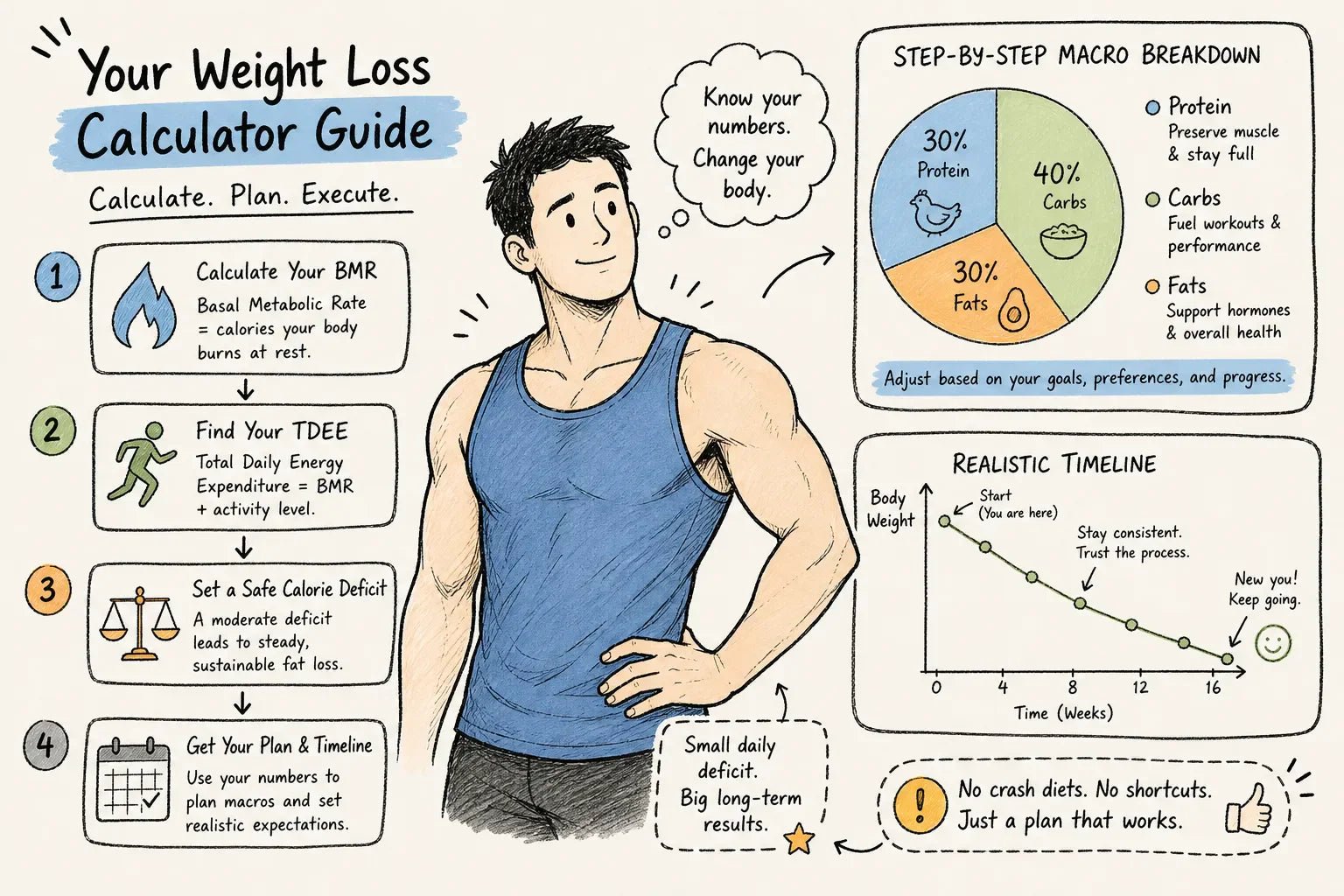
One pound of fat equals roughly 3,500 calories. A 500-calorie daily deficit removes one pound per week; a 1,000-calorie daily deficit removes two. To find your target, follow three steps:
- Calculate your BMR using the Mifflin-St Jeor equation.
- Apply your activity factor, multiply by 1.2 if you're sedentary, or 1.55 if you're moderately active. The result is your Total Daily Energy Expenditure (TDEE), your maintenance number.
- Set your deficit, subtract 500 to 750 calories from your TDEE, and you have your daily calorie target.
For a step-by-step walkthrough that automates these calculations and explains each variable, see The Ultimate Weight Loss Calculator Guide (2026).
Calorie needs vary significantly by gender and activity level. Sedentary women aiming to lose weight typically land in the 1,300 to 1,900 calorie range. Moderately active women can eat 1,500 to 2,100 calories and still lose consistently. Sedentary men generally need 1,700 to 2,500 calories; moderately active men 1,900 to 2,800. The hard floor, regardless of profile, is 1,200 calories per day for women and 1,500 for men. Below those thresholds, nutrient deficiency and metabolic slowdown become genuine risks.
If you want more detail on how to use your BMR to inform meal timing and calorie distribution, this guide on how to use BMR to hack your diet can be a practical companion to the steps above.
Building your macros around what keeps you full
Protein is the anchor of every effective weight-loss diet plan, and the research is clear on why. It amplifies gut hormones that signal fullness, specifically PYY, GLP-1, and CCK, while suppressing ghrelin, the hormone that drives hunger. For anyone in a calorie deficit, the target is 1.6 to 2.2 grams of protein per kilogram of body weight daily, or roughly 25 to 30% of total calories. Practically, that means 20 to 40 grams of protein per meal, distributed across the day. This is also the primary driver of lean muscle preservation while you're eating below maintenance.

The highest-protein, lowest-calorie foods to build meals around include skinless chicken breast, nonfat Greek yogurt, egg whites, cottage cheese, shrimp, canned tuna, and lentils. These foods make your calorie budget go furthest without leaving you hungry two hours later. For additional ideas and a concise list of high-protein choices to include in meal planning, check this overview of high-protein foods for weight loss.
Soluble fiber is the other half of the satiety equation. It slows gastric emptying, increases chewing time, and provides volume without dense calories. Research consistently shows that increasing fiber intake significantly reduces total calorie consumption across the day. The goal is to build meals that are high in both protein and fiber simultaneously. Vegetables, legumes, oats, berries, and whole grains are your primary sources. Healthy fats from olive oil, nuts, and fatty fish round out the macro picture without undermining the deficit.
A Beginner-Friendly 4-Week Lose Weight Diet Plan
A well-structured calorie deficit meal plan at 1,500 calories includes three meals and one to two snacks per day. This structure gives you enough eating occasions to stay ahead of hunger without blowing your daily budget. Here's what a sample week looks like in practice:
- Monday: Bircher muesli for breakfast; whole wheat bread with cheddar, tomato, and vegetables for lunch; chili con carne with cauliflower for dinner; a pear and banana as snacks.
- Tuesday: Whole wheat toast with peanut butter for breakfast; butternut squash and cranberry bean stew for lunch; mackerel with tomatoes and a whole wheat pita for dinner; clementines and a small bran muffin as snacks.
- Wednesday: Berry oatmeal for breakfast; chicken wrap with salad for lunch; baked sweet potato with broccoli and feta for dinner; an apple with 10 grams of almonds as a snack.
- Thursday: Wheat cereal with 2% or low-fat milk for breakfast; whole wheat sandwich with cheddar and salad for lunch; grilled lemon chili chicken with couscous and corn for dinner.
Friday through Sunday follow the same pattern with variations like spinach pancakes, pasta salad, and mixed vegetable curry. The structure stays consistent even when the ingredients rotate.
To scale down to a 1,200 calorie meal plan: remove one snack, cut any dessert to a half portion, and reduce starchy carbohydrate portions slightly (one slice of bread instead of two). To scale up to 1,800 calories: add one to two extra snacks such as a handful of nuts and a piece of fruit, increase starchy carbohydrate portions slightly, and incorporate more healthy fats. The protein and vegetable targets stay fixed regardless of calorie level. Those two variables don't shift with the number.
For weeks 2 through 4, the key is rotating through the same food groups with different combinations. Breakfasts cycle through oatmeal, eggs, yogurt bowls, and smoothies. Lunches vary between soups, wraps, salads, and stews. Dinners rotate through fish, chicken, lean beef, and plant-based proteins. This approach makes a weekly diet plan for weight loss practical without requiring a culinary degree or a new grocery store every Sunday.
Habits that make the plan stick beyond week one
Skipping meals is one of the most reliable ways to derail a calorie deficit. It produces extreme hunger that leads to reactive overeating later in the day. Eating at consistent times daily conditions your appetite hormones and reduces impulsive food decisions. Eating protein first at each meal, before carbohydrates or fats, triggers fullness signals earlier and reduces total intake at that sitting. Solid foods also outperform liquids for satiety because they require more chewing and digest more slowly.
Thirst is frequently misread as hunger. Staying adequately hydrated, roughly 64 ounces of fluids daily, removes one common source of false hunger signals. When snacking, pair a protein with a produce item: Greek yogurt with berries, apple slices with string cheese, or a hard-boiled egg with cucumber. These combinations extend satiety without pushing you over your daily calorie budget. People who succeed long-term are typically the ones who have these habits automated.
Medical considerations before you start cutting calories
A calorie deficit is safe for most healthy adults, but there are clear contraindications to address before starting. Pregnant and breastfeeding women should not enter a calorie deficit. People with type 1 diabetes face serious ketoacidosis risk. Those taking SGLT2 inhibitors, a class of diabetes medication, face a specific and severe metabolic risk from low-calorie eating. Individuals with heart failure, renal insufficiency, or a documented history of eating disorders need medical clearance first.
Type 2 diabetics can benefit significantly from a calorie deficit, but medication adjustments, particularly with insulin, must be made under physician supervision to avoid hypoglycemia. If any of the above applies to you, the plan outlined here is not a replacement for medical guidance. Talk to your doctor first, get clearance, and then build your approach from there.
The only system you actually need
A sustainable diet plan for weight loss doesn't have to be complicated. It's a calorie target you can maintain, macros weighted toward protein and fiber, a weekly rotation of real meals, and a handful of consistent daily habits. The 1 to 2 pound per week target isn't a limitation. It's the pace at which real fat loss happens without destroying muscle or tanking your metabolism.
Start with your calorie range, calculate your TDEE, subtract 500 to 750 calories, and build your first week around this lose weight diet plan framework. Most people who succeed at weight loss aren't more disciplined than those who fail. They built a simpler, more realistic system and stuck to it. That's the whole game. For a quick online tool to plug in your stats and get your calorie target, try this calorie calculator. If you prefer a guided read-through before you try the tool, see The Ultimate Weight Loss Calculator Guide (2026), Español or the The Ultimate Weight Loss Calculator Guide (2026), Deutsch.
Training quality and recovery matter alongside nutrition. If you're working out to preserve muscle while in a deficit, IonicFire's high-performance activewear is built for that purpose. Compression construction supports blood flow and reduces post-workout soreness, so you can train consistently without unnecessary downtime.

Hinterlasse einen Kommentar
Diese Website ist durch hCaptcha geschützt und es gelten die allgemeinen Geschäftsbedingungen und Datenschutzbestimmungen von hCaptcha.