
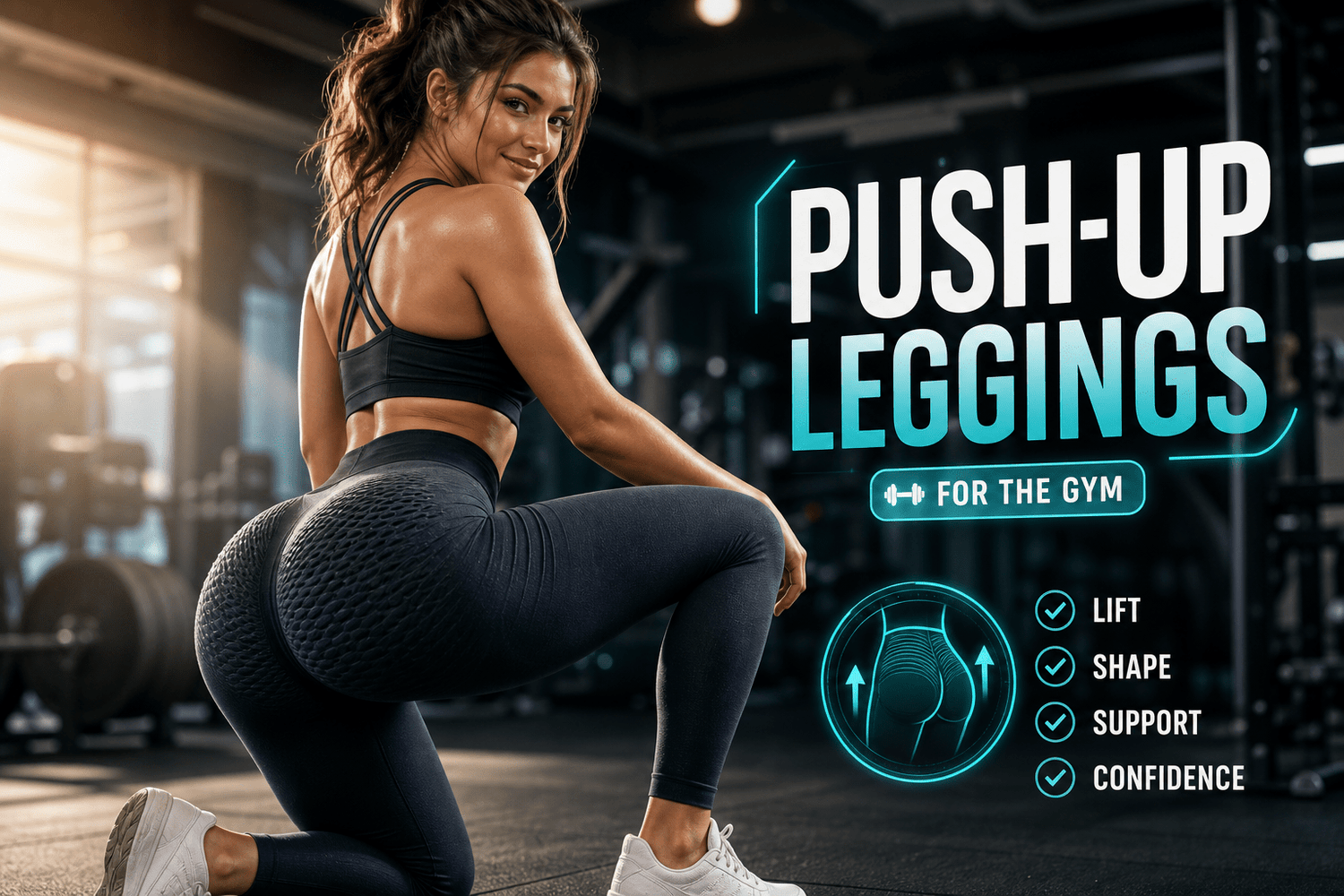
Here is a confession that almost every woman who trains regularly has lived through at least once. You find a pair of leggings online, they are labeled "pushup," the model looks incredible, the reviews say things like "lifted and sculpted," and you buy them. They arrive, you put them on, and they feel... tight. That is it. Just tight. No lift, no shape, no difference from the plain black leggings you already owned. You wonder if your body is the problem. It is not.
The "pushup legging" label has been stretched so thin (pun intended) that it now means almost nothing by itself. Brands apply it to everything from genuinely engineered garments to basic stretch fabric with a trendy hangtag. Once you understand what actually creates the lifting effect, you can see through the noise in about thirty seconds. That understanding starts at the level of how fabric behaves under tension.
At IonicFire, we built our women's legging collection from engineering principles first and trend language second. What follows is the same framework we use internally, laid out so you can apply it to any brand you are evaluating, not just ours.
The real mechanic behind pushup leggings: it is not just compression
The intuitive assumption is that tighter equals more lift. If the fabric squeezes everything together, something must go up, right? This is actually the wrong mental model, and it is the reason so many pushup leggings fail the moment you move in them. Uniform compression, the kind where the entire fabric presses with the same force in every direction, tends to flatten rather than lift. It compacts the shape instead of framing it.
What creates the lifting effect is something different: directional fabric tension. This is the principle that the tension in a fabric panel can be oriented so it pulls upward and inward against the natural curve of the glute, rather than simply pushing straight in from all sides. Think of the structural difference between a well-engineered supportive bra and a tight bandage wrapped around the same area. One shapes by redirecting force, the other just applies pressure. The distinction matters enormously when you are on your feet and moving.
Why four-way stretch matters for pushup legging performance
Directional tension only works if the fabric can respond differently along different axes. This is where four-way stretch, meaning the fabric stretches both lengthwise and widthwise, becomes essential. Two-way stretch fabrics can limit a pattern-maker's design options depending on knit structure and grain direction, because they do not offer equal response across all planes of movement. Four-way stretch gives the pattern cutter more control: panels can be oriented so that the less stretchy axis runs in the direction where support is needed most, typically under and around the glute, while the more elastic axis accommodates movement in every other direction. The result is a legging that holds its shape under load, moves with you through a full squat, and still creates visible lift when you are standing still.
Seam placement: the most underrated factor in glute lift
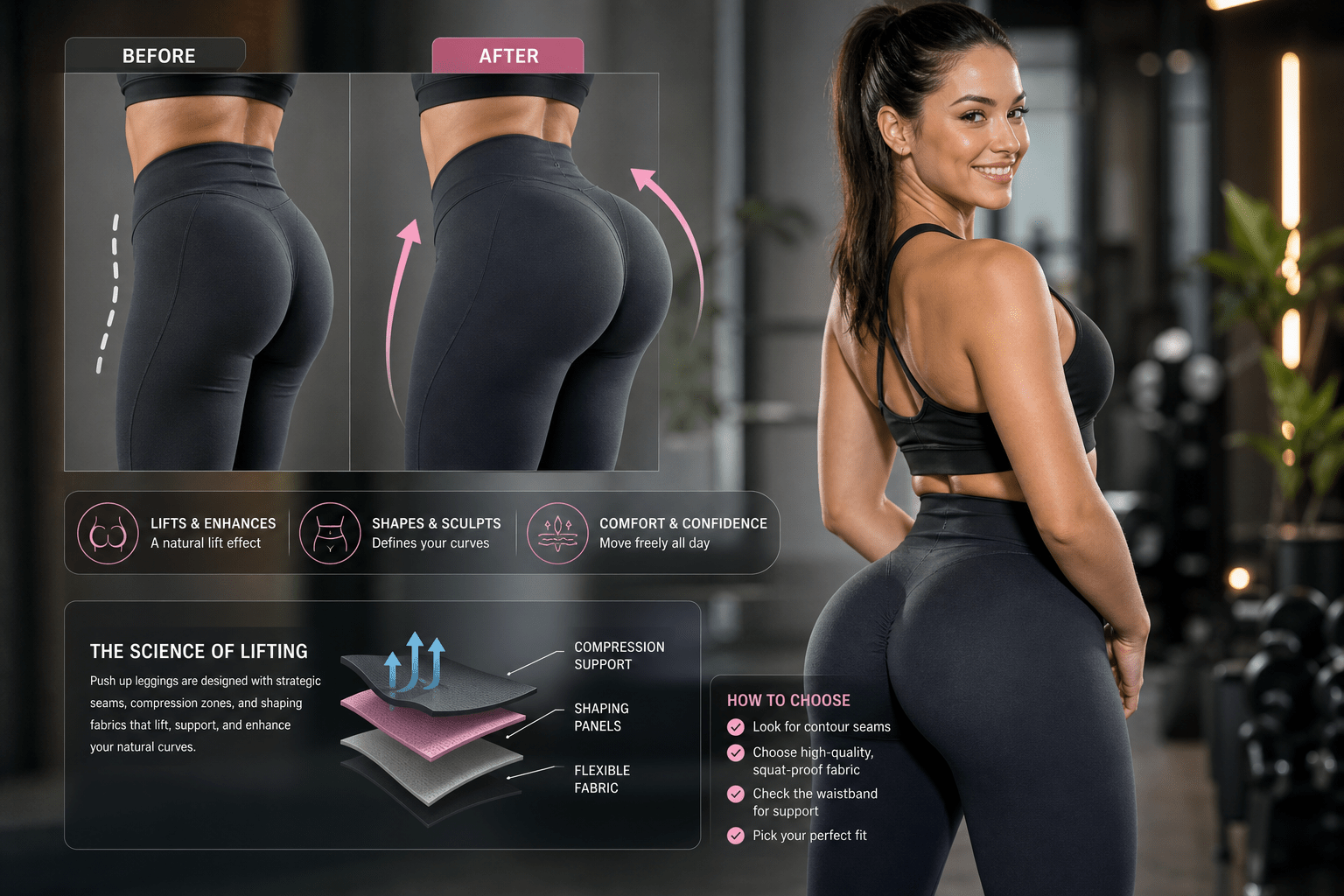
If directional fabric tension is the engine, seam placement is what steers it. Seams are not just stitching that holds panels together. In a well-constructed pushup legging, they act as structural guides that reinforce and redirect the tension built into the fabric. A legging can have excellent four-way stretch fabric and still completely fail at lifting if its seams run straight down the back with no structural shaping. This explains why some leggings look promising on the hanger and deliver nothing once worn.
The geometry that creates lift uses a curved rear seam that follows the natural contour of the glutes rather than cutting straight across them. When this seam curves upward through the back panel and a separate contour seam runs beneath the glute shelf, the combination frames the muscle from below while the fabric tension works from the sides. The eye perceives the glute as fuller, more rounded, and more projected, not because anything is padded or enhanced, but because the construction is directing both fabric and visual attention in the right direction.
What poor seam design looks like in practice
You can identify under-engineered seam construction before you even try the legging on. Look for rear panels that are a single flat piece of fabric with no seam shaping at all. Look for seams that run perfectly vertical through the back with no curve or angle. The waistband is equally telling: if it sits low and runs straight across with no V-shape or upward curve at the back, it is not contributing to lift, it is working against it. These are not manufacturing shortcuts taken by careless brands. They are design choices that reveal whether the brand started from engineering or from marketing.
Compression zones and what they actually do for your shape
There is a meaningful difference between a legging that compresses and a legging that shapes. Targeted compression zones apply varying levels of pressure in specific areas rather than pushing uniformly across the whole garment. Higher compression at the thigh and waistband anchors the structure and holds everything in place. A strategic release zone around the glute allows the natural curved shape to fill out rather than being flattened by constant pressure from all sides. The result is a legging that feels supportive without feeling like a compression sleeve, and that creates visible shaping as a byproduct of thoughtful construction.
Uniform compression, by contrast, applies the same pressure everywhere. It smooths and holds, which has value, but it tends to create a compacted, flattened look in the posterior rather than a lifted one. This is the type you will find in most basic "compression leggings" that do not specifically engineer for shape. Both types have uses; they are not the same product, even when they look identical on a rack.
Where shaping and performance compression overlap
The same zone compression design that creates aesthetic lift also supports muscle function during training. Graduated compression reduces tissue vibration during dynamic movement, which can decrease muscle fatigue during longer sessions. In some leggings, this structural thinking is layered with technologies designed to support microcirculation during activity. At IonicFire, select women's legging styles combine zone compression with ionic fiber and Far Infrared Radiation (FIR) technology for exactly this reason: the shaping effect and the recovery-support effect are not competing priorities; they come from the same structural thinking. A legging built from real engineering tends to perform better and look better at the same time.
Fabric technologies that separate genuine performance from marketing claims
The tag on a legging rarely tells you the things that actually matter. Fabric recovery percentage, grams-per-square-meter weight, and the quality of the elastane blend used to achieve compression are seldom listed on packaging for mass-market garments, yet these are the factors that determine whether a legging maintains its compression and shape after fifty washes or starts sagging after ten. If you want those specifications, look for a brand's tech sheet or product detail page rather than the hangtag. A well-constructed pushup legging uses a nylon-spandex or nylon-elastane blend with enough density to hold structure without becoming rigid, and enough elastane quality to recover its shape fully after every stretch cycle.
What the fabric spec sheet does not tell you
A too-light fabric weight cannot create compression structure regardless of how it is cut. A high elastane percentage does not automatically mean more compression. What matters is the specific blend ratio and the knit density. Lower-grade elastane alternatives may degrade faster under repeated washing and UV exposure, which is why some leggings lose their lift effect after a season of regular use even though they felt great on day one. Asking about fabric weight and elastane quality before you buy is worth the thirty seconds it takes.
How IonicFire approaches technical legging construction
IonicFire's women's leggings are built from four-way stretch construction with compression zone design as the baseline, not as an add-on feature. Select styles layer ionic fiber technology and FIR into the fabric, marketed to support microcirculation and recovery during and after training. The starting point was always the question of what the garment needs to do structurally, not what terms would look good on a product page. That distinction shows up in how the leggings perform over time rather than just on the first wear.
Matching your leggings to how you actually train
Not every pushup legging is built for every type of training. A legging engineered for yoga flow has different structural requirements than one designed to survive heavy squats and hip thrusts. Getting this match right is where most buyers make their final and most avoidable mistake. Guides like the ultimate guide to women's leggings walk through those trade-offs by activity and can help narrow choices. Knowing your primary training style before you shop narrows the field considerably.
For heavy lifting, the non-negotiables are a high waistband that stays put under a barbell, rear seams that do not roll or dig in during deep hip flexion, and fabric that maintains opacity under full load. Squat see-through is a real failure mode in leggings with insufficient fabric density, and it happens most often in garments designed for lighter activity and then marketed broadly. For HIIT, running, and dynamic movement, the focus shifts. You need fabric that snaps back quickly after each stride rather than staying slack, chafe-free seam placement at the inner thigh, and a waistband that does not migrate during jumping or lateral cuts. These are different performance demands that call for different construction priorities. For examples of leggings specifically built to handle heavy training, see leggings for lifting.
What to check before you buy: a practical fit guide
Theory and fit testing are two different things. You can understand every principle in this article and still buy the wrong pair if you skip a few basic physical checks. These four tests take about two minutes and tell you more than any product description will.
- The squat test: squat deep and check for transparency at the seat and thighs. If fabric pulls thin under tension, the construction cannot support heavy training.
- The bend-and-move test: hinge forward and twist side to side. The waistband should not roll, and the seams should not dig into or pull away from the body.
- The side-profile check: look at the shape from the side in a mirror. A legging that works lifts and rounds the glute. A legging that fails just compresses it flat.
- The fabric recovery test: stretch the fabric firmly between your hands and release. It should snap back immediately with no slack. Poor recovery indicates a higher risk of losing shape over time, check the manufacturer's laundering or recovery specs where available.
Red flags that signal poor pushup legging construction
The warning signs are consistent across brands and price points. A fabric that feels very light and non-compressive will not deliver structural lift, regardless of what the marketing says. A single rear panel with no seam shaping is a clear sign the brand did not engineer for the glute curve. A wide, flat waistband with no grip lining and no V-back design will roll down under any real training load. Elastic that feels more stiff than springy on a stretch test may indicate a lower-quality blend with a higher risk of faster degradation. Any one of these flags is worth pausing on. Find three in the same pair and put them back.
IonicFire's women's legging collection was designed to meet all four fit criteria from the first wear. If you want a hands-on benchmark for what engineered construction actually feels like, start there and you will know exactly what you are comparing everything else against.
Now you can actually read the label
That "pushup" label looks completely different once you understand the mechanics behind it. You are no longer reading a marketing claim; you are asking a technical question: is the directional fabric tension working upward? Are the seams curved and contoured to frame the glute? Are the compression zones graduated rather than uniform? These are answerable questions, and you now know how to answer them.
The best pushup leggings for the gym in 2026 are not the ones with the most impressive product copy. They are the ones where fabric tension direction, seam geometry, and compression zone design are all working together in the same direction, literally. That is not magic or marketing. It is construction.
If you want to see what this looks like in practice, explore IonicFire's women's legging collection. Once you know what to look for, you will not go back to guessing, and you will stop wondering whether the leggings failed you or the other way around. They failed you. Now you know why, and how to find the ones that will not.

Leave a comment
This site is protected by hCaptcha and the hCaptcha Privacy Policy and Terms of Service apply.