
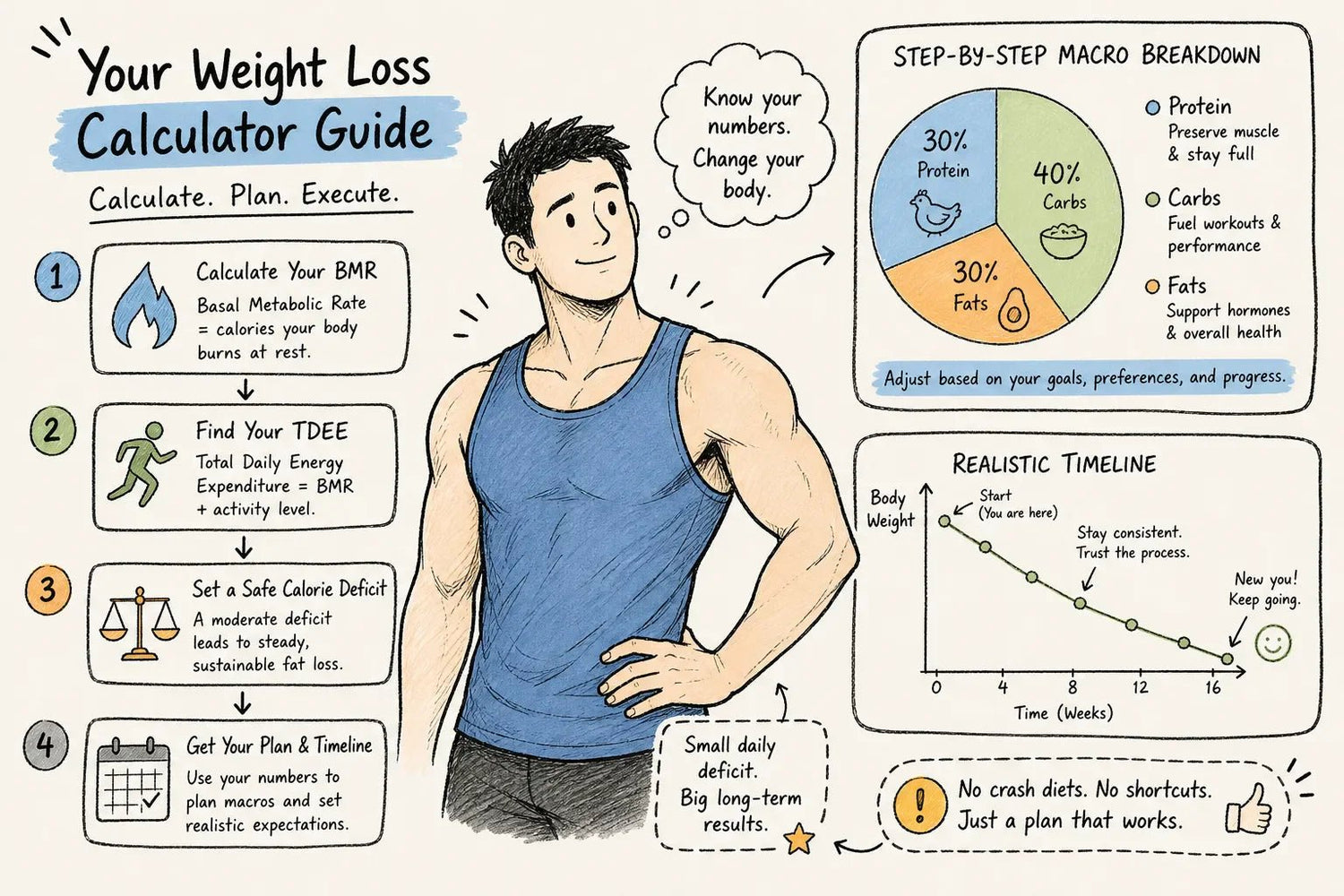
Calculate Calories, Macros, Fat Loss
Realistic Timelines
Most people do not fail to lose weight because they lack motivation.
They fail because they are working with the wrong numbers.
Some drastically under-eat, crash their energy levels, and quit after two weeks. Others think they are “in a calorie deficit” while unknowingly eating at maintenance calories the entire time. In both cases, the result is the same: frustration, inconsistency, and a scale that barely moves.
A proper weight loss calculator eliminates guesswork.
Instead of relying on generic advice like “eat 1,200 calories a day,” this guide shows you how to calculate your actual calorie needs based on:
- body weight
- height
- age
- activity level
- training frequency
- metabolism
- long-term adaptation
You will learn:
- how to calculate your BMR
- how to determine your TDEE
- how many calories to eat to lose weight
- how to set a sustainable calorie deficit
- how to calculate macros
- why weight loss slows down over time
- how training frequency affects fat loss
- how recovery impacts metabolism
- why consistency matters more than perfection
This is not a crash-diet guide.
It is a framework designed for sustainable fat loss while preserving muscle, energy, performance, and long-term adherence.
Why Most Online Weight Loss Calculators Are Wrong

Many calorie calculators online are technically “correct,” but practically useless.
Why?
Because they:
- underestimate real-world metabolism variability
- ignore training consistency
- overestimate calorie burn
- assume static energy expenditure
- fail to account for metabolic adaptation
- ignore NEAT (Non-Exercise Activity Thermogenesis)
Your body is dynamic.
As your body weight changes, your calorie expenditure changes too.
That means your calorie target should evolve throughout your fat loss phase, not remain fixed forever.
This guide explains how to do that correctly.
Step 1 — Calculate Your Basal Metabolic Rate (BMR)
Your Basal Metabolic Rate (BMR) represents the number of calories your body burns at complete rest.
This includes:
- breathing
- circulation
- organ function
- hormone production
- body temperature regulation
- cellular repair
Even if you stayed in bed all day doing absolutely nothing, your body would still burn calories to keep you alive.
BMR usually accounts for:
- 60–75% of total daily calorie expenditure
Which means:
your metabolism matters far more than most people think.
The Most Accurate BMR Formula: Mifflin-St Jeor Equation

The most widely validated formula for modern calorie calculations is the Mifflin-St Jeor equation.
Compared to older formulas like Harris-Benedict, it generally produces more accurate estimates for modern populations.
Men
BMR =
(4.536 × weight in lbs) +
(15.88 × height in inches) −
(5 × age) + 5
Women
BMR =
(4.536 × weight in lbs) +
(15.88 × height in inches) −
(5 × age) − 161
Example BMR Calculation
Example 1 — Male
- Age: 30
- Weight: 180 lbs
- Height: 5'11" (71 inches)
Calculation:
(4.536 × 180) +
(15.88 × 71) −
(5 × 30) + 5
= 816.5 + 1,127.5 − 150 + 5
= ~1,799 kcal/day
Example 2 — Female
- Age: 30
- Weight: 143 lbs
- Height: 5'5" (65 inches)
Calculation:
(4.536 × 143) +
(15.88 × 65) −
(5 × 30) − 161
= 648.6 + 1,032.2 − 150 − 161
= ~1,370 kcal/day
Why BMR Is NOT Your Fat Loss Calories
This is one of the biggest mistakes people make.
Your BMR is NOT:
- your cutting calories
- your maintenance calories
- your daily intake target
It is only your baseline resting expenditure.
To calculate real-world calorie needs, you must determine your:
Total Daily Energy Expenditure (TDEE)
Step 2 — Calculate Your TDEE
TDEE stands for Total Daily Energy Expenditure.
This includes:
- BMR
- workouts
- walking
- digestion
- standing
- fidgeting
- daily movement
- occupational activity
This is the number that actually determines whether:
- you lose weight
- maintain weight
- gain weight
Understanding Activity Multipliers
Your TDEE is calculated by multiplying your BMR by an activity factor.
Sedentary — ×1.2
Minimal movement, desk job, little exercise.
Lightly Active — ×1.375
Light training 1–3 times/week.
Moderately Active — ×1.55
Moderate training 3–5 times/week.
Very Active — ×1.725
Hard training 6–7 days/week.
Extra Active — ×1.9
Athletes or physically demanding jobs with intense daily activity.
Most People Overestimate Their Activity Level
This is extremely common.
Training 3 times per week does NOT automatically make someone “very active.”
If:
- you sit most of the day
- have a desk job
- average low step counts
then your real multiplier is usually lower than you think.
Even a small overestimation can completely erase your calorie deficit.
The Hidden Fat Loss Variable: NEAT
One of the most overlooked fat loss factors is NEAT:
Non-Exercise Activity Thermogenesis.
This includes:
- walking
- pacing
- standing
- cleaning
- posture
- unconscious movement
- fidgeting
NEAT can vary by:
- hundreds of calories per day
between two people of identical size.
This is why some people “eat more and still lose weight.”
Their daily movement is simply higher.
Increasing daily steps is often one of the easiest ways to improve fat loss without aggressive dieting.
How Training Frequency Changes Your TDEE
Example:
Male BMR = 1,799 kcal
Training 3x/week
1,799 × 1.55
= ~2,789 kcal/day
Training 6x/week
1,799 × 1.725
= ~3,103 kcal/day
That is:
- 314 additional calories per day
- over 2,000 calories per week
This is why consistent training matters so much.
A higher TDEE allows:
- more food
- better recovery
- improved gym performance
- easier adherence
- less hunger
- better muscle retention
Step 3 — Create a Safe Calorie Deficit
Weight loss ultimately requires:
- consuming fewer calories than you burn
This is called a calorie deficit.
The 500-Calorie Rule
Roughly:
- 3,500 calories ≈ 1 lb of body fat
So:
500 kcal/day deficit
≈ 1 lb/week weight loss
1,000 kcal/day deficit
≈ 2 lbs/week weight loss
This aligns with guidance from organizations like:
- CDC
- NHS
- Academy of Nutrition and Dietetics
Why Aggressive Dieting Usually Backfires
Very large deficits often cause:
- fatigue
- muscle loss
- binge eating
- poor sleep
- hormone disruption
- training performance decline
- metabolic adaptation acceleration
People often assume:
“faster weight loss = better”
But adherence is the real predictor of success.
A smaller deficit maintained consistently almost always beats an aggressive diet abandoned after 3 weeks.
Minimum Safe Calories
Most evidence-based guidelines recommend not consistently dropping below:
Women
~1,200 kcal/day
Men
~1,500 kcal/day
Going below these levels substantially increases risk of:
- nutrient deficiencies
- muscle wasting
- hormonal issues
- metabolic slowdown
- rebound weight gain
Why Weight Loss Slows Down Over Time
This is completely normal.
As you lose weight:
- your body mass decreases
- your calorie burn decreases
- your metabolism adapts
A deficit that worked initially becomes smaller over time.
This process is called:
Metabolic Adaptation
Your body becomes more energy efficient during prolonged dieting.
This includes:
- lower resting metabolic rate
- lower NEAT
- reduced spontaneous movement
- increased hunger hormones
- reduced satiety signaling
This is biology — not failure.
The Hormones Behind Diet Fatigue
Long-term calorie restriction affects:
- leptin
- ghrelin
- cortisol
- thyroid hormones
This explains why:
- hunger increases
- cravings intensify
- energy drops
- recovery worsens
Understanding this helps prevent unnecessary self-blame during plateaus.
Why Scale Weight Can Be Misleading
The scale does not only measure fat.
Daily fluctuations come from:
- water retention
- sodium intake
- glycogen storage
- inflammation
- stress
- menstrual cycle changes
- digestion
It is completely normal for body weight to fluctuate:
- 2–6 lbs within days
This is why trends matter more than single weigh-ins.
The Most Accurate Fat Loss Projection Tool
Static calorie math has limitations.
A more accurate model is the:
NIDDK Body Weight Planner
It accounts for:
- changing metabolism
- changing body weight
- adaptation over time
Unlike basic calculators, it produces more realistic:
- 3-month
- 6-month
- 12-month projections
based on dynamic energy balance research.
Step 4 — Calculate Your Macros
Calories determine weight change.
Macros influence:
- muscle retention
- hunger
- recovery
- training performance
- satiety
Protein: The Most Important Macro During Fat Loss
Protein helps:
- preserve muscle
- reduce hunger
- improve recovery
- maintain metabolic rate
A good target:
- 0.7–1.0g per pound of goal body weight
Example:
Goal weight = 160 lbs
Protein target:
- 112–160g/day
Fat Intake
Dietary fat supports:
- hormones
- brain health
- recovery
- nutrient absorption
Recommended minimum:
- 20–30% of calories
OR - ~0.3–0.4g/lb body weight
Carbohydrates
Carbs primarily support:
- training output
- recovery
- glycogen replenishment
- performance
After setting:
- protein
- fat
the remaining calories go toward carbohydrates.
Example Macro Split (1,800 kcal)
Protein
160g = 640 kcal
Fat
60g = 540 kcal
Carbs
155g = 620 kcal
Daily total:
- 160g protein
- 60g fat
- 155g carbs
Why Recovery Matters More Than Most People Realize
Fat loss is not only about training harder.
Recovery quality directly affects:
- consistency
- performance
- sleep
- injury risk
- adherence
Poor recovery often leads to:
- skipped sessions
- lower TDEE
- reduced calorie burn
- stalled progress
The Role of Training Apparel in Performance & Recovery
Comfort, thermoregulation, compression, and mobility all influence training quality more than most people realize.
Technical activewear designed for:
- breathability
- movement support
- temperature regulation
- recovery comfort
can improve training consistency across weeks and months.
IonicFire focuses on performance-oriented activewear engineered to support training frequency, comfort, and recovery — all factors that indirectly contribute to maintaining a higher TDEE and more sustainable fat loss adherence.
Common Weight Loss Mistakes
Eating Too Little
Often causes burnout and binge cycles.
Ignoring Liquid Calories
Drinks can easily add hundreds of unnoticed calories.
Inconsistent Tracking
Most people underestimate intake significantly.
Overestimating Calorie Burn
Fitness watches are often inaccurate.
Training Too Hard Too Soon
Unsustainable plans rarely last.
Expecting Linear Progress
Fat loss naturally fluctuates.
The Most Sustainable Fat Loss Strategy
The best fat loss plan is not:
- the fastest
- the most restrictive
- the most extreme
It is the one you can realistically maintain for months.
Long-term success usually comes from:
- moderate deficits
- high protein intake
- consistent training
- sufficient recovery
- realistic expectations
- periodic recalculation
Final Takeaway: Make the Math Work for You
Here is the complete process:
- Calculate your BMR
- Determine your TDEE
- Set a realistic calorie deficit
- Build your macro targets
- Train consistently
- Prioritize recovery
- Recalculate every 4–6 weeks
- Focus on long-term adherence
Your metabolism is dynamic.
Your calorie targets should be too.
When you combine:
- accurate calorie math
- realistic expectations
- proper recovery
- sustainable habits
fat loss becomes far more predictable, manageable, and maintainable long term.
And that is exactly what a good weight loss calculator should help you achieve.


Commenta
Questo sito è protetto da hCaptcha e applica le Norme sulla privacy e i Termini di servizio di hCaptcha.